 Skip-the-line available
 How the Veiled Christ was carved from a single block
The commission, the sculptor who got it after Corradini died, the payment order that settles the alchemy legend, and what to look for when you stand beside it.
Almost everyone who sees the Veiled Christ for the first time has the same reaction: that cannot be stone. The shroud seems to cling to the body like wet linen, thin enough to show the ribs, the sunken side and the face beneath it. For more than two and a half centuries the effect was so convincing that people preferred a supernatural explanation to a human one, and the story that the veil was a real cloth turned to marble by an alchemist prince still circulates in Naples today. The truth is more impressive. This guide tells the story of the commission, the young Neapolitan sculptor who carried it out, the documents that prove how it was made, and the details worth looking for when you are standing a metre away from it.
The commission
The statue was commissioned by Raimondo di Sangro, seventh Prince of Sansevero, who from the 1740s was rebuilding his family's burial chapel into a single, carefully planned scheme. Every work in the room had a role in his programme, and the dead Christ lying under a shroud was meant to be its emotional centre.
His first choice of sculptor was Antonio Corradini, a Venetian with a European reputation who had worked for the emperor in Vienna. Corradini was a specialist in veiled figures, and he had already carved Modesty for the chapel, a woman wrapped in a transparent veil, dedicated to the prince's mother. He was the obvious man for the job.
Corradini died in 1752 before he could carve the Christ. All he left was a terracotta model, a small study of the composition, which survives today in the Museo di San Martino on the hill above the city.
So the prince turned to a young local sculptor, Giuseppe Sanmartino. The museum quotes the brief he was given: a life-sized marble statue of the dead Christ, covered in a transparent shroud carved from the same block as the statue. One block, one figure, one veil. It is hard to imagine a more demanding specification for a sculptor still making his name.
A Neapolitan answer to a Venetian model
Sanmartino had Corradini's model to work from, and the museum is clear that he paid it little heed. Where Corradini's veils are elegant and controlled, a finishing layer laid over a body, Sanmartino's shroud is restless. The folds twist and tighten. They do not decorate the body so much as press against it.
The museum's own description is that the veil, meant as a compassionate covering, seems to make the limbs more exposed rather than less, and the lines of the tortured body more precise. That is the paradox at the heart of the statue. The cloth hides nothing. It is a cover that reveals.
The result is late Baroque in feeling rather than in fashion: less concerned with graceful surface than with the drama of a body after death. It also launched Sanmartino's career. He went on to a long working life in Naples, but nothing he made afterwards is as famous as this.
The statue was finished in 1753 and placed at the centre of the nave, where it still lies. It is the first thing you see when you walk in and the last thing you look back at before you leave.
The alchemy legend
Raimondo di Sangro was a real experimenter. He ran laboratories beneath his palace on Piazza San Domenico Maggiore, invented colours, mastics and printing methods, and enjoyed a reputation, partly cultivated by himself, as a man who knew secrets other people did not. It was a short step from there to the legend that the veil of the Christ was not carved at all.
The story goes like this: the prince laid a real cloth over the finished statue and, by some chemical process of his own, turned the fabric to stone. Travellers repeated it, guidebooks repeated it, and some academics believed it. The museum notes that for more than 250 years visitors have mistakenly thought the transparency of the shroud was the result of an alchemical "marblisation".
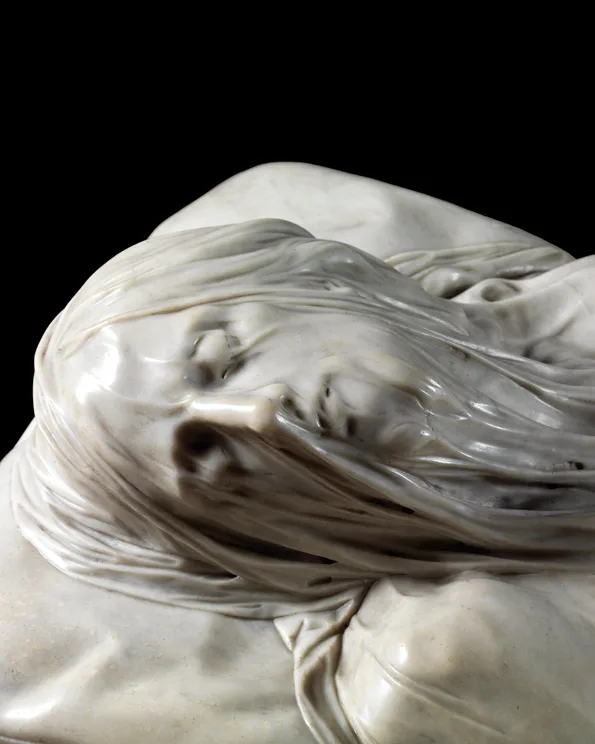
It is easy to see why. The edges of the veil are fine enough to look frayed. The cloth seems to sink into the eye sockets and the open mouth. Over the feet and the hands it lies so close that you can read the wounds through it. Standing beside it, the explanation that a chisel did this can feel less likely than magic.
But the legend is wrong, and we know it is wrong from the prince's own hand.
The payment that settles it
The Historical Archive of the Bank of Naples preserves a payment order dated 16 December 1752, signed by Raimondo di Sangro. It authorises a deposit of fifty ducats to Giuseppe Sanmartino for, in the prince's words, the statue of Our Dead Lord covered with a veil of marble. The full cost of the work came to five hundred ducats, a remarkable sum.
That single line, "a veil of marble", in a banking document written before the statue was finished, is the best evidence there is. The prince was paying for a carved veil.
He said the same thing elsewhere. In letters to the French physicist Jean-Antoine Nollet and to Giovanni Giraldi of the Accademia della Crusca, he described the transparent shroud as made from the same block as the statue. His eighteenth-century biographer, Giangiuseppe Origlia, wrote that the Christ was covered by a transparent veil of the same marble.
So the Veiled Christ is entirely carved from one block of stone. The museum puts it well: the absence of any trickery makes the statue more fascinating, not less. The prince did enjoy the mystery. He himself remarked that the veil was crafted with such finesse that even the most discerning observers were left spellbound, and that was exactly the effect he wanted.
What to look for
When you stand by the statue, the rope barrier keeps you a short step away, close enough to see the surface clearly. Take it slowly, from head to feet.
Start with the face. The veil sinks into the eyes and the half-open mouth, and on the forehead you can see a swollen vein, still raised beneath the cloth. The museum points to it as one of the signs of how far Sanmartino pushed the realism.
Move down to the chest and the side. The body is thin, the ribs show, and the side is sunken, relaxed at last in death. The shroud follows every hollow.
Look at the hands and the feet. The nail wounds are visible through the veil, on the thin hands and on the feet. The cloth seems to lie almost flat against them.
Then look at the edges of the shroud. Sanmartino worked them like embroidery, with a fine fringe that is the most delicate carving in the statue.
Finally, look at the floor of the bed at Christ's feet. The instruments of the Passion are laid there: the crown of thorns, the pincers and the nails. They are easy to miss on a first look because your eye is pulled to the body, but they are some of the sharpest carving in the room.
Why it has the reputation it has
The statue drew admirers from the start. The museum records that Antonio Canova, the great Neoclassical sculptor, tried to buy it during a stay in Naples, and that legend has him saying he would have given ten years of his life to have carved it.
Writers came too. The Marquis de Sade, in his travel memoirs, praised the folds and the finesse of the veil. The Neapolitan writer Matilde Serao described the passion written in the features of the face. The conductor Riccardo Muti used the face for the cover of a recording of Mozart's Requiem.
More recently the statue has become a symbol of Naples itself. The museum notes that a survey at a book fair in the city in 2006 named it the monument that best represents Naples, and that the regional government chose a photograph of it for a campaign promoting the city's image in 2008.
What all of that reputation can do is raise expectations. What it cannot prepare you for is how intimate the statue is in person. It is life-sized, lying low on its marble bed, in a room that is smaller than most people imagine. You are not looking up at a monument. You are looking down at a body.
How the statue fits the chapel
The Veiled Christ was not made as a stand-alone showpiece. It belongs to a set. Together with Corradini's Modesty and Francesco Queirolo's Disillusion, the man struggling free of a marble net, it forms the trio that travellers and art historians have singled out since the eighteenth century. Each is a feat of carving that seems to defy the material: a veil, a veil, and a net.
The prince's letters also show he once planned a different home for it. In the Underground Chamber he designed an oval funerary temple, lit from above, where the Christ was to lie between two eternal lamps of his own design. The project was never completed, and the museum thinks it highly unlikely the statue was ever placed there. A marble slab at the centre of the chamber marks where he intended it to go.
So when you visit, see the Christ first, then look to the pillars on either side at the altar end to compare Modesty and Disillusion, and then go down to the chamber where the prince imagined it lying. The three works and the empty space below tell you a great deal about what he was trying to build.
Making the most of your minutes beside it
Because the chapel is small and entry is timed, the room never feels like a crush, but there is always someone else waiting to stand where you are standing. A little planning helps you see more.
Walk in and resist the urge to go straight to the statue. Stop just inside the door and take in the whole nave first: the Christ lying low in the centre, the Virtues on the pillars, the vault overhead. The statue was designed to be seen in that setting, and the first view from the entrance is one of the best.
Then go to the Christ and give it time. Walk its length once quickly, then again slowly. Most visitors stay ten minutes or more here, and nobody will hurry you.
If you like context as you look, the optional audio guide covers the statue in detail as part of a route of about 25 minutes. It comes in Italian, English, Spanish, French and German, and there is a separate route for children aged 6 to 12. It is rented at the museum and collected as you go in.
Leave your phone in your pocket. Photography and phone use are not allowed, which most people find a relief once they are inside. It is a rare chance to look at a famous work without a screen between you and it.
Finally, come back to the statue on your way out, after you have seen Modesty, Disillusion and the Underground Chamber. Knowing that the prince once meant it to lie in the room below, lit by eternal lamps, changes how you see it a second time.
Frequently asked
Is the Veiled Christ really carved from one piece of marble?
Yes. The prince's payment order of 16 December 1752 refers to a statue covered with a veil of marble, and his letters say the shroud was carved from the same block as the body. The alchemy story is a legend.
Who carved the Veiled Christ?
Giuseppe Sanmartino, a young Neapolitan sculptor, in 1753. The commission first went to Antonio Corradini, who died in 1752 having made only a terracotta model, now in the Museo di San Martino.
Can I photograph the Veiled Christ?
No. The museum does not allow photography, video or phone use anywhere inside. Most visitors find the quiet room is part of what makes the statue so affecting.
How close can I get to the statue?
The statue lies at the centre of the nave behind a low rope barrier, a short step away. From there you can see the face, the hands, the feet and the instruments of the Passion clearly.