 Skip-the-line available
 What to see inside the Cappella Sansevero, work by work
A walk through the nave, the altar, the vault and the floor, then down to the Underground Chamber, with what to look for at each stop.
The Cappella Sansevero holds almost thirty works of art in one nave, and nearly all of them were planned by a single patron as parts of one scheme. That makes it a room that rewards a little preparation. Most visitors walk straight to the Veiled Christ, stand there for ten minutes, and leave having barely noticed the two other statues that eighteenth-century travellers ranked alongside it, the colours of the vault, or the fragments of a lost labyrinth floor at their feet. This guide takes you around the chapel in the order you will meet things, with a short note at each stop on what it is and what to look for.
How the room is laid out
You enter a single nave that ends in an apse with the high altar. Each side wall has four round arches. Most of them hold a tomb of one of the prince's ancestors. The exceptions are the third arch on the left as you enter, which holds the side door, and the third arch on the right, which opens on to the tomb of Raimondo di Sangro himself.
Against the pillars between the arches stand the statues of the Virtues. The museum explains that these are dedicated to the women of the family, past and present, with one exception: Disillusion, which honours the prince's father. They are the heart of his design, read as stages on a path towards inner knowledge.
The Veiled Christ lies in the middle of the nave. Above everything is the barrel vault, broken by six deep windows. Below, a staircase near the prince's tomb leads to the Underground Chamber, and the route ends in the sacristy. Your ticket covers all of it.
A practical note: photography is not allowed, so it helps to know in advance what you want to look at closely.
The Veiled Christ
Start where everyone starts. Giuseppe Sanmartino's statue of 1753 shows the dead Christ lying on a mattress and two cushions, covered from head to foot by a shroud carved from the same block of marble.
Walk slowly along its length. On the face, the veil sinks into the eyes and the mouth, and a swollen vein is still visible on the forehead. The wounds from the nails show through the cloth on the hands and the feet. At the feet lie the instruments of the Passion: the crown of thorns, the pincers and the nails. The fringed edge of the shroud is worked like embroidery.
The statue is so convincing that for centuries people believed the prince had turned a real cloth into stone by alchemy. He had not. His own payment order to the sculptor, dated 16 December 1752, refers to a statue covered with a veil of marble.
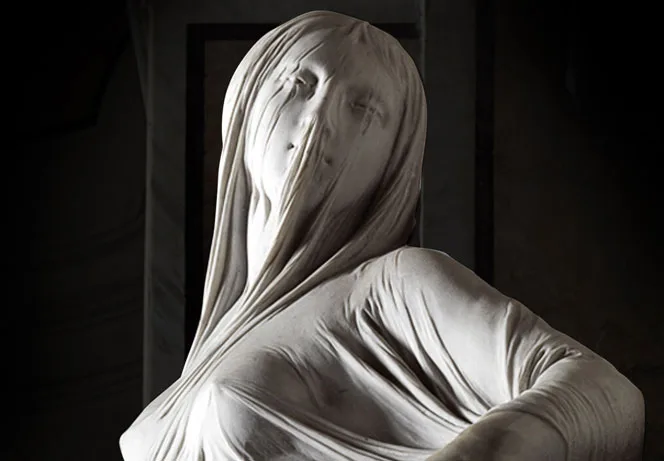
Modesty
On a pillar towards the altar end stands Modesty, the Pudicizia, by the Venetian sculptor Antonio Corradini, finished in 1752. It is dedicated to the prince's mother, Cecilia Gaetani, who died in December 1710, before he was a year old.
A young woman stands wrapped in a veil so fine and so close to the body that the museum compares it to cloth dampened by the smoke of incense. A garland of roses circles her waist. Beside her is a broken plaque and a tree of life, both symbols of a life cut short. On the base is a relief of Noli me tangere, the risen Christ appearing to Mary Magdalene in the garden.
Look at how differently the veil behaves from the one on the Christ. Corradini's is calm and clinging. Sanmartino's is restless. It was Corradini who was first meant to carve the Christ, and comparing the two shows you why the result surprised everyone.
The figure has also been read as an allegory of Wisdom, and as a reference to the veiled Isis.
Disillusion
Opposite Modesty is Disillusion, the Disinganno, by the Genoese sculptor Francesco Queirolo, carved in 1753 and 1754. English sources also call it Release from Deception. It honours the prince's father, Antonio, who after a wild and wandering life returned to Naples in old age and became a priest.
A man struggles free of a great net, helped by a winged genius with a small flame on its forehead, the symbol of human intellect. The genius points to a globe at the man's feet, the world and its passions, on which rests an open Bible. The relief on the base shows Christ restoring sight to the blind.
The net is the reason people stop here. It is cut entirely in marble, free of the body in places, and so delicate that, according to the story the museum tells, the craftsmen who usually polished statues refused to touch it for fear it would shatter, and Queirolo had to finish it himself with pumice. Origlia called it the last and most trying test to which sculpture in marble can aspire.
The other Virtues and the family tombs
Modesty and Disillusion are the famous two, but they are part of a series. Statues of Virtues stand against the pillars all down the nave, each paired with the family member it honours, and most follow the allegories in Cesare Ripa's Iconologia, an illustrated handbook the prince later paid to have reprinted.
Look for Decorum by Corradini, Liberality, Sincerity and Education by Queirolo, Religious Zeal by Fortunato Onelli, the Sweetness of the Marital Yoke by Paolo Persico, and Self-control by Francesco Celebrano. A statue of Divine Love was added by an unknown sculptor in the nineteenth century.
In the arches between them are the tombs of the prince's ancestors, several of them from the seventeenth-century chapel that Alessandro di Sangro built. In a niche to the left of the altar is Alessandro himself, the Patriarch of Alexandria, shown in prayer.
Before you leave the nave, turn round and look above the main door. The monument to Cecco di Sangro, by Celebrano, shows an armed warrior bursting out of a sarcophagus. It recalls an episode from a campaign in Flanders when Cecco hid for two days before surprising the enemy and taking the fort of Amiens. It is one of the most theatrical pieces in the room, and many visitors walk out beneath it without ever looking up.
The high altar
At the end of the nave is the high altar, with a large marble relief of the Lamentation by Francesco Celebrano. The museum considers it his finest work and notes it is the only high relief on a high altar in any Neapolitan church. The bodies crowd into the frame: the dead Christ, the grieving Mary, the Magdalene.
Look at the frame around the relief. Its blue is not lapis lazuli but a substance made in the prince's laboratory to imitate it. Below the altar table, a small putto lifts the lid of an empty tomb. On either side of the steps stand two angels by Paolo Persico.
Above the altar, in a burst of stucco angels, hangs a painting of the Pietà by an unknown Neapolitan artist of the late sixteenth century. This is the image linked to the chapel's founding legend: around 1590 a man led to prison in chains saw it appear when part of the garden wall collapsed, and the first small chapel was built in thanks.
The vault
Now look up. The whole barrel vault is a single fresco, the Glory of Heaven, also known as the di Sangro Paradise, painted by Francesco Maria Russo in 1749. Painted architecture opens into clouds, and at the centre the dove of the Holy Spirit bursts out of a triangular halo, with medallions of the family's saints between the windows. Over the sanctuary, a small false dome is painted on the flat ceiling.
The colours are what you notice. The blues, greens and golds are still intense more than 250 years later, and the museum credits a formula invented by the prince himself. Ironically, he was not satisfied with the fresco. In his will he asked his son to have it repainted by the best painter he could find. His son never did.
The triangle at the centre carries several meanings at once: the Trinity for Christians, cosmic birth in the Pythagorean tradition, and the Venerable Master in Masonic symbolism.
The floor and the prince's tomb
The floor you are walking on is not the one the prince designed. His floor, laid by Francesco Celebrano from the mid-1760s, was a polychrome marble labyrinth in which a single unbroken line of white marble wound through the whole nave. It was badly damaged when part of the building collapsed in 1889, and the restorers replaced it with Neapolitan terracotta tiles glazed in yellow and blue, the colours of the di Sangro arms.
Some of the original slabs survive in the passage in front of the prince's tomb. Look for the hooked crosses formed by the continuous white line and the concentric squares drawn in perspective in shades from blue to white.
The tomb itself is the sober monument in the third arch on the right. Its long inscription is not carved but raised, white letters standing out from the slab with no trace of a chisel, made with a chemical process the prince devised. Around it are arms, armour, books, set squares, a globe, and the sash of the Order of San Gennaro.
Down to the Underground Chamber
From the passage by the tomb, a staircase leads down to the Underground Chamber. It is a narrow nineteenth-century spiral stair, and the chamber is the one part of the museum that wheelchair users cannot reach.
The prince planned this room as an oval funerary temple for his descendants, and intended the Veiled Christ to lie at its centre between two eternal lamps. It was never finished. Today it holds the two Anatomical Machines, the upright skeletons of a man and a woman wrapped in a reconstructed network of veins, made by the Palermo doctor Giuseppe Salerno in the 1750s, and a large fragment of the original labyrinth floor.
The route ends in the sacristy, which also serves as the museum's bookshop. Before you leave, step back into the nave and look once more at the Christ from the altar end. It is a different statue from that angle.
Frequently asked
What are the three most famous works in the Cappella Sansevero?
The Veiled Christ by Giuseppe Sanmartino (1753), Modesty by Antonio Corradini (1752) and Disillusion by Francesco Queirolo (1753 to 1754). Travellers and art historians have singled out these three since the eighteenth century.
Is the floor of the Cappella Sansevero original?
No. The prince's labyrinth floor was ruined in a collapse in 1889 and replaced with yellow and blue terracotta tiles. Original slabs survive in front of his tomb, in the Underground Chamber and in the sacristy.
Who painted the ceiling of the Cappella Sansevero?
Francesco Maria Russo, in 1749. The fresco is called the Glory of Heaven, and its colours were made with a formula of the prince's own invention.
How long should I allow inside?
The museum sets no time limit. Forty minutes to an hour lets you see the main works, look up at the vault and visit the Underground Chamber without rushing. The optional audio guide runs about 25 minutes.