 Skip-the-line available
 The Anatomical Machines under the Cappella Sansevero
Two skeletons wrapped in their own network of veins, a Palermo doctor, a prince's private apartment, and the dark legend that still follows them.
Most people come to the Cappella Sansevero for the Veiled Christ and leave talking about what they saw downstairs. At the end of the visit a narrow staircase takes you into a vaulted room below the chapel, and there, in two tall glass cases, stand the skeletons of a man and a woman, upright, each wrapped in a dense web of arteries and veins. They are called the Anatomical Machines, and they are among the strangest objects on display anywhere in Italy. This guide explains what they are, who made them and when, what the latest research says about the veins, how the legend of murdered servants grew up, and what you need to know before you go down the stairs.
What you will see
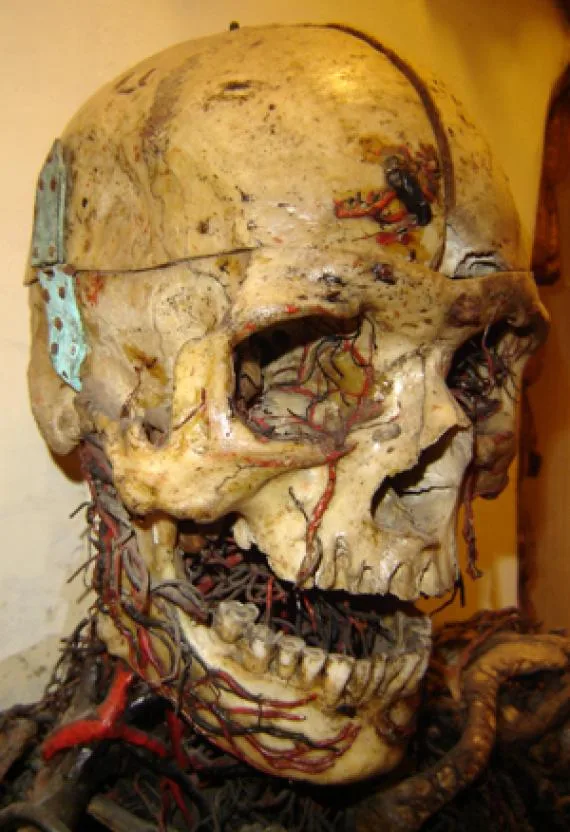
The Machines stand in the Underground Chamber, a room beneath the chapel reached at the end of the museum route. There are two of them, each in its own glass case: the skeleton of a man and the skeleton of a woman, both standing upright.
What makes them extraordinary is not the bones but what surrounds them. Each skeleton carries a nearly complete arteriovenous system, the network of blood vessels that runs through the body, from the large vessels of the chest down to fine threads in the hands and feet. In the skull, the vessels trace the face and the tongue. The effect is of a human figure drawn in red and blue line.
They are unsettling, and they are meant to be. They are also, once the first jolt passes, remarkable pieces of eighteenth-century science. Most visitors spend only a few minutes in the chamber, but it is worth a slower look at the hands and the head, where the finest work is.
If you are visiting with children, it is worth a word beforehand. The Machines are not gory, there is no flesh, but they are real human skeletons, and some younger visitors find them more frightening than fascinating.
Who made them
The Machines were made by Giuseppe Salerno, a doctor from Palermo. The museum cites eighteenth-century sources showing that Raimondo di Sangro, the seventh Prince of Sansevero, bought the male machine in 1756 after Salerno exhibited it publicly in Naples.
The prince was impressed enough to take Salerno into his service, granting him a substantial annual pension, and commissioned him to make the second, female machine.
That detail matters, because it puts the Machines where they belong: in the world of eighteenth-century anatomy, where demonstration models of the body were prized by doctors, collectors and the curious alike. Raimondo di Sangro was all three. He ran laboratories beneath his palace, experimented in chemistry and mechanics, and took a serious interest in medicine.
There is a design detail that confirms the Machines were meant for study. The female skeleton originally stood on a base that could be turned right round so that every part could be observed. That is the language of an anatomical teaching model, not a curiosity cabinet.
The Apartment of the Phoenix
The Machines were not made for the chapel. They were first kept in a room of the prince's palace on Piazza San Domenico Maggiore called the Apartment of the Phoenix.
We know this because travellers described them there, and because an anonymous eighteenth-century guide to the palace and the chapel, the Short Note on What Can Be Seen in the House of the Prince of Sansevero, lists them. That guide describes the Machines in detail, from the vessels of the head to those of the tongue. It also records that at the feet of the woman lay the tiny body of a foetus, with the open placenta attached by the umbilical cord.
The name of the room is worth pausing on. The phoenix is the bird that rises from its own ashes, an old symbol of resurrection and immortality. The museum points out that housing two bodies of veins and bone in a room named for it was hardly accidental. The prince liked to amaze his visitors, and he liked his symbols.
Long after his death, the two Machines were moved into the chapel, which is how they survived when much else from the palace was lost. The foetus remained visible until a few decades ago, when it was stolen.
How the veins were made
For more than two centuries the great question about the Machines has been how the blood vessels were preserved so well. The Short Note spoke of an injection, suggesting that under the prince's direction Salerno had injected a substance into the vessels of two bodies to make them hard and metallic. That idea, sometimes called human metallisation, fed the prince's dark reputation for generations.
The current answer is less macabre. According to the museum, the circulatory system is a reconstruction, built up from different materials including beeswax and colourants. Studies reported in English-language sources describe wax, iron wire and silk.
What is still surprising is the accuracy. The reconstruction follows the arteriovenous system down to its finest vessels, showing an anatomical knowledge that was very advanced for the time. The museum notes that a research group has recently suggested that injection experiments may have been carried out before the reconstruction, as a way of mapping the vessels. That debate is open. The Machines are still, more than 250 years later, among the most enigmatic objects in the complex.
The legend of the servants
No object in Naples has attracted darker stories. The philosopher and historian Benedetto Croce recorded the popular belief that the prince had two of his servants killed, a man and a woman, and had their bodies strangely embalmed so that they showed all the viscera, arteries and veins.
It is a gripping tale and it has been retold endlessly, in guidebooks, novels and documentaries. But it is a legend. The evidence points to Salerno as the maker, to the male machine being bought ready-made in 1756, and to the vessels being a wax reconstruction rather than a preserved circulatory system.
Why did the story stick? Partly because Raimondo di Sangro encouraged an aura of mystery around everything he did. He was famously reluctant to reveal how his inventions worked, wrote about a perpetual flame and secret processes, and was a leading Freemason in a city where that was dangerous. His book, the Lettera Apologetica, was banned by the Church. A man like that, with two human skeletons in a room named for the phoenix, was always going to collect legends.
It is the same pattern as the Veiled Christ upstairs, where people for generations preferred an alchemical explanation to a sculptor's genius. In both cases the true story is the better one.
The room itself
The Underground Chamber was never finished. The prince designed it as a small funerary temple for his descendants, oval in shape, half above and half below the level of the nave, meant to look as though it had been cut from the rock and lit by a cupola with windows. Eight arches would have held the marble caskets of the family.
At its centre, according to his letters, he planned to place the Veiled Christ, lit by two eternal lamps of his own design at its head and feet. It is very unlikely the statue was ever moved there, but a marble slab at the centre of the room marks the spot he had in mind.
Today the chamber keeps its oval shape and holds the two glass cases and a large fragment of the chapel's original eighteenth-century floor, the labyrinth pavement that was ruined in a collapse in 1889. It is worth a look on your way past the Machines: a single continuous line of white marble winding through blue and white inlay.
Before you go down
The chamber is part of every ticket. Your entry covers the nave of the chapel, the Underground Chamber and the sacristy, and the route takes you through all three in that order.
Access is by a narrow nineteenth-century spiral staircase. The museum is clear that wheelchair users and visitors with reduced mobility can see the whole nave, including the Veiled Christ, and the sacristy, but not the Underground Chamber. If anyone in your party has difficulty with stairs, they can wait in the nave while the others go down.
The usual house rules apply below as above. Photography, video and phone use are not allowed anywhere in the museum, so this is one of those rare places you will have to remember rather than record.
If you want more context, the optional audio guide covers the whole route, including the chamber, in about 25 minutes, in Italian, English, Spanish, French or German. It is rented at the museum, not included with entry.
Visiting with children
Children are welcome at the chapel. Those up to 9 enter free, though they still need a place on the booking, and there is an audio guide route written for ages 6 to 12, narrated by a character called Gennarino, the prince's faithful servant.
The Anatomical Machines are the part to think about in advance. Some children are fascinated by them, especially if they already like bones, bodies and museums of natural history. Others find two real skeletons in a dim vaulted room more than they bargained for. You know your own children best. A short, matter-of-fact explanation before you go down usually helps: two skeletons, made for doctors to study more than 250 years ago, with the blood vessels rebuilt in wax.
If a child would rather not go down, the chamber is easy to skip. The stair leads off the nave and the route continues to the sacristy, so one adult can wait upstairs with the Veiled Christ while the others visit.
How long to spend downstairs
The museum sets no time limit for any part of the visit, and the Underground Chamber is small. Five to ten minutes is enough for most visitors to look properly at both cases and the floor fragment.
It is worth timing your visit so you are not rushing this part. If you have booked a late slot, remember that the last entry is 30 minutes before closing, at 18:30 on a normal day, and leave enough of your visit for the room below as well as the nave.
Frequently asked
Are the Anatomical Machines real human skeletons?
Yes. The skeletons of a man and a woman are real. The blood vessels around them are a reconstruction in materials including beeswax and colourants, made by the Palermo doctor Giuseppe Salerno in the 1750s.
Were the Anatomical Machines made from murdered servants?
That is a popular legend, recorded by Benedetto Croce, not history. The male machine was bought by the prince in 1756 after Salerno exhibited it in Naples, and the female was commissioned afterwards.
Is the Underground Chamber included in the ticket?
Yes. Every entry covers the nave, the Underground Chamber with the Anatomical Machines, and the sacristy.
Is the Underground Chamber wheelchair accessible?
No. It is reached by a narrow nineteenth-century spiral staircase. Wheelchair users can visit the entire nave, including the Veiled Christ, and the sacristy.