 Skip-the-line available
 Raimondo di Sangro, the prince behind the chapel
Soldier, inventor, publisher, Freemason and patron: the life of the man who planned every work in the Cappella Sansevero, and the myths he left behind.
Every work in the Cappella Sansevero answers to one man. Raimondo di Sangro, seventh Prince of Sansevero, chose the artists, set the subjects, sometimes invented the materials, and arranged the whole room as a single message he never fully explained. He was also a soldier, a member of Italy's leading language academy, a printer whose book was banned by the Church, the first Grand Master of Neapolitan Freemasonry, and an experimenter whose palace laboratory became one of the sights of Grand Tour Naples. Knowing a little about him changes how you see the chapel. This guide covers his life, his inventions, the scandal that marked him, the chapel he built, and the legends that have grown around him since.
A precocious start
Raimondo di Sangro was born on 30 January 1710 in Torremaggiore, in Puglia, where the family held most of its lands. His mother, Cecilia Gaetani dell'Aquila d'Aragona, died in December of the same year, before he was one. His father, Antonio, Duke of Torremaggiore, spent long periods away from Italy, and the boy was raised by his grandfather Paolo, the sixth prince, in the family palace on Piazza San Domenico Maggiore in Naples.
He was clearly gifted. His biographer Giangiuseppe Origlia wrote of his brightness of spirit and remarkable quickness, and he was sent to the Jesuit college in Rome, then the most prestigious school of its kind. There he excelled at philosophy and languages, mastering at least eight, and studied pyrotechnics, natural science, hydrostatics and military architecture.
At sixteen he came into the title, after his father renounced it. By 1737 he had settled permanently in the palace in Naples, now the capital of a new kingdom under Charles of Bourbon. He married his cousin Carlotta Gaetani, and the philosopher Giambattista Vico wrote a sonnet for the couple.
The soldier and inventor
The young prince quickly made a name as an inventor. In 1729 he designed a folding stage for a theatrical performance. By 1739 he had built a hydraulic device and an arquebus that could fire with either powder or compressed air, which he presented to the king. In 1741 he invented a cannon that weighed considerably less than others of its type and fired further.
He was a serving soldier, too. As colonel of a provincial regiment he fought at the battle of Velletri against the Austrians in 1744, and in 1747 he published a manual of infantry exercises that won praise from Louis XV of France and Frederick II of Prussia. In 1740 he was made a Knight of the Order of San Gennaro, an honour reserved for a small circle around the crown.
His curiosity ran in every direction. The museum lists firework displays in colours never seen before, a waterproof cloth he gave to the king, medicines, and a method of printing several colours in a single pull of the press using devices he designed himself. Later came artificial gems and coloured marbles, experiments in desalinating seawater, and a great musical clock on the little bridge that once joined his palace to the chapel.
The scandal of 1751
In 1743 the prince was admitted to the Accademia della Crusca, the authority on the Italian language. The following year he obtained papal permission to read prohibited books, and he read widely: the French philosophers, the radical thinkers of the early Enlightenment, the alchemists, and the Masonic tradition.
In 1750 he became Grand Master of the Neapolitan lodge of Freemasons. In 1751 Pope Benedict XIV condemned Freemasonry, and King Charles followed with an edict. The prince had no choice but to abjure.
The same year his own press printed his most famous book, usually called the Lettera Apologetica. On its surface it was a defence of a study of the quipu, the knotted-cord records of the Incas. In practice it ranged over many dangerous subjects and quoted many unorthodox authors. Critics called it a sink of heresy, and the Church placed it on the Index of prohibited books, where it stayed despite the prince's appeal to the pope.
Disappointed, he turned inward to what he called experimental physics. Under his palace he installed a great furnace and a chemical laboratory, and from it came letters about a mysterious perpetual light, sent to the Florentine scholar Giovanni Giraldi and later published in French for the physicist Jean-Antoine Nollet.
Building the chapel
The family chapel was older than the prince. It began around 1590 as a small votive chapel, Santa Maria della Pietà, and was enlarged in 1613 by Alessandro di Sangro, Patriarch of Alexandria, into a family mausoleum. Raimondo inherited its outline and from the 1740s set out to transform the interior completely.
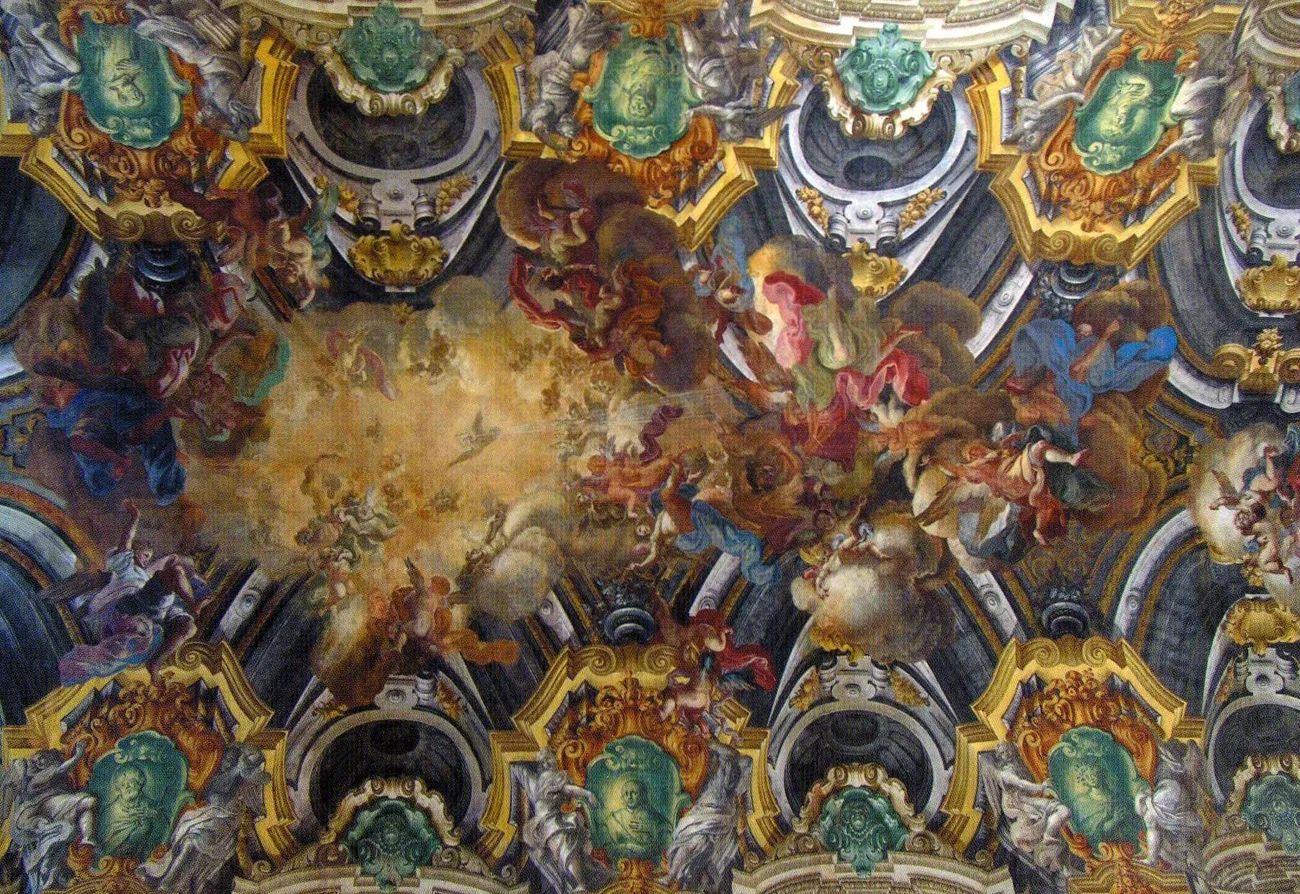
He worked the way he did everything else: personally and in detail. He kept the simple single nave with four arches on each side, but filled it with new works by the best sculptors and painters he could find, and supplied materials of his own invention. The vault fresco by Francesco Maria Russo, the Glory of Heaven, was painted in 1749 with colours the prince prepared, and the museum notes they are still remarkably bright.
The great sculptures followed: Antonio Corradini's Modesty in 1752, dedicated to the mother he never knew; Giuseppe Sanmartino's Veiled Christ in 1753; Francesco Queirolo's Disillusion in 1753 and 1754, dedicated to his father. Around them came the other Virtues by Queirolo, Celebrano and Persico.
Even the details carry his inventions. His own tomb, designed in 1759, has an inscription in relief that shows no chisel marks, made with a chemical process he devised. From the mid-1760s Francesco Celebrano laid a labyrinth floor of inlaid marble using a method the prince had explained to him. In his will he asked his heirs not to change anything in the arrangement.
A room with a message
The museum describes the chapel as a noble mausoleum and a temple of initiation at the same time. Each work had a role in an overall scheme that the artists themselves were probably not told about.
Some of the symbolism is plain. Modesty and Disillusion honour his mother and father. The Virtues lining the nave pair with the tombs of his ancestors. Other readings are more debated. The veiled woman of Modesty has been read as an allegory of Wisdom and linked to the veiled Isis. Disillusion, the man freeing himself from a net with the help of a winged genius, has been read as an image of Masonic initiation: the blindfold removed, the eyes opened to a new light. The triangle at the centre of the vault, and the labyrinth floor, carry meanings in Christian, classical and Masonic traditions at once.
You do not need to accept any particular theory to feel the effect. The room is unusually coherent. Everything points somewhere, and walking through it, you sense a single mind arranging what you see.
His last years
The last fifteen years of the prince's life were marked by serious money troubles and by cooler relations with the court after King Charles left for Spain in 1759. He published nothing after a 1756 dissertation on an ancient lamp, to avoid more censure, but he kept up his experiments and his correspondence with scholars across Europe. The astronomer Lalande, after meeting him, wrote that he was not an academician but an entire academy.
In July 1770 he made his last spectacular public appearances. On several Sundays he crossed the bay of Naples, from Capo Posillipo to the Ponte della Maddalena, in a sea-going carriage of his own invention driven by paddle wheels. He died at Palazzo Sansevero on 22 March 1771. According to the sources the museum cites, the illness that killed him was caused by his own chemical preparations.
His tomb in the chapel calls him an extraordinary man, gifted in all he dared to undertake, a famous investigator into the most recondite mysteries of Nature.
The legend of the prince
Raimondo di Sangro helped create his own myth. He wrote about the products of his wonderful genius, announced discoveries like the perpetual flame without revealing the methods, and opened his palace to travellers who left astonished. Add his noble birth, his Freemasonry and a banned book, and a legend was inevitable.
Over the centuries it grew dark. Popular stories turned him into a sorcerer: the man who turned a real veil to marble, who had two servants killed to make the Anatomical Machines. Both stories are false. The Veiled Christ was carved from one block by Sanmartino, as the prince's own payment order shows, and the Machines were made by the doctor Giuseppe Salerno, with the vessels reconstructed in wax.
At the end of the nineteenth century writers including Luigi Capuana, Salvatore Di Giacomo and Benedetto Croce revived interest in him, and in recent decades historians have placed his work in the context of the European Enlightenment. The museum's own view is that the mystery should not hide the real man: a refined, cosmopolitan intellectual of an extraordinary age in Naples.
The palace next door
The chapel was never meant to stand alone. It sat beside the family palace on Piazza San Domenico Maggiore, and until 1888 a passageway connected the two buildings. The prince could walk from his laboratories and his Apartment of the Phoenix straight into his family's mausoleum, and visitors to the palace were shown both.
The palace still stands on the square, a short walk from the chapel door. Its grand portal dates from 1621. It is not part of the museum and is not open as an attraction, but it is worth a look from the square before or after your visit, if only to picture the eighteenth-century travellers who came here to see the prince's inventions.
Much of what those travellers described is gone. The great musical clock on the bridge between palace and chapel, the furnaces, the printing press and most of the prince's experiments are lost. What survives of his world is almost entirely in the chapel, which is part of why it carries so much of his legend.
Seeing him in the chapel
You can find the prince himself in several places on your visit. His portrait hangs in the chapel, painted by Carlo Amalfi. His tomb, near the passage to the Underground Chamber, is the sober monument with the relief inscription, framed by arms, armour, books, set squares and a globe, with the sash of the Order of San Gennaro hanging from one side.
In front of the tomb, look down: some slabs of his labyrinth floor survive in the passage. More pieces are in the Underground Chamber, where the two Anatomical Machines he bought and commissioned stand in their cases. And above everything is the vault, still glowing in colours he made himself.
Frequently asked
Who was Raimondo di Sangro?
The seventh Prince of Sansevero (1710 to 1771), a Neapolitan nobleman, soldier, writer, publisher, inventor and the first Grand Master of Neapolitan Freemasonry. He designed the whole scheme of the Cappella Sansevero and commissioned its masterpieces.
Was Raimondo di Sangro an alchemist?
He studied alchemical texts and ran a chemical laboratory under his palace, and he enjoyed a reputation for secret knowledge. The famous legends, the veil turned to marble and the murdered servants, are not true.
Where is Raimondo di Sangro buried?
In the Cappella Sansevero. His tomb, designed in 1759, has an inscription in relief made with a chemical process of his own, and stands near the passage to the Underground Chamber.
Why was his book banned?
His Lettera Apologetica, printed in 1751 on his own press, touched on many unorthodox ideas and authors. The Church judged it heretical and placed it on the Index of prohibited books.